
Walk around any good craft fair and you’ll see the usual suspects: textiles, ceramics, jewelry, natural cosmetics, woodwork. But there’s another group of makers quietly growing: people who forge blades, grind edges and build cutting tools that are as beautiful as any piece of jewelry.
If you’re one of those makers – or you sell cutting tools alongside other handmade goods – you already know the challenge:
how do you bring knives to a family-friendly fair without making organizers nervous or scaring off visitors?
This guide is meant exactly for you: a practical walk-through of how to sell handmade knives and cutting tools at craft markets in a way that’s safe, responsible and easy for organizers to approve.
Start with the right mindset: tools, not weapons
The first thing to understand is perception.
Most organizers are not knife people. When they hear “cuchillos” or “navajas”, their brain jumps straight to risk:
security issues, bad press, or problems with local regulations.
Your job is to frame your work as tools:
- Kitchen knives for home cooks and food stalls
- Carving and woodworking tools for artisans
- Compact outdoor or camp knives for hikers and campers
- Small utility blades for everyday tasks
When you talk to an organizer or a visitor, keep bringing the conversation back to:
- Function – what everyday job the tool is designed for
- Craft – forging, grinding, heat treatment, handle work, finish
- Care – how to use and store the knife safely
Phrases that help:
- “These are kitchen tools for home cooking and food prep.”
- “This is a carving knife designed for woodworkers.”
- “These are compact outdoor tools for camping and hiking – not tactical items.”
That framing – tools, craft, function – sets the tone for everything else: your display, your signage, even your pricing.
Choose the right products for a craft fair
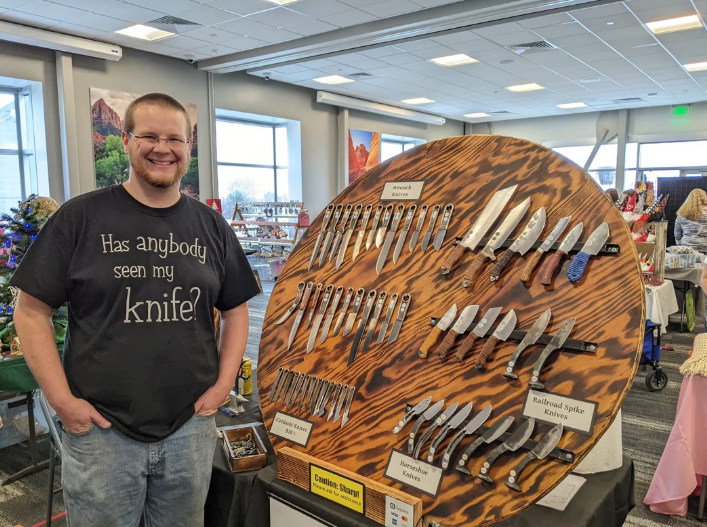
Not every blade that leaves your workshop belongs on a festival table. For most craft fairs, stick to pieces that clearly look like tools or art objects, not combat gear.
Good candidates:
- Kitchen knives
- Chef’s knives, santoku, petty knives, small paring knives
- Matching pairs or small sets for home cooks
- Cutting tools for makers
- Woodcarving knives, leatherworking knives, small chisels
- Compact outdoor tools
- Simple fixed blades with modest blade length
- Clean, non-aggressive profiles without “tactical” styling
- Letter openers and decorative blades
- Blunt or semi-blunt edges as desk art
Things to avoid or keep separate for more specialized events:
- Oversized “fantasy” blades or anything that looks like a weapon from a movie
- Knives with military, cartel or gang-style imagery
- Automatic or gravity knives where local rules may be strict
- Anything you yourself would hesitate to show at a school-friendly event
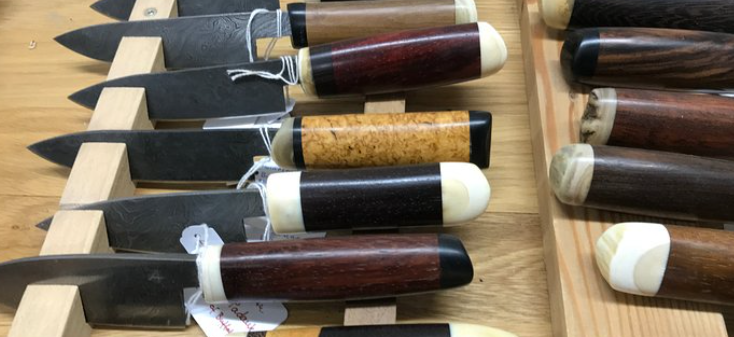
If you also make high-end custom knives – complex Damascus, gold inlays, carved handles – you can still bring one or two as “showpieces.” Those are perfect when you talk about examples of professionally finished custom knives and for showing what’s possible at the top end of your craft, even if most sales will be simpler pieces.
Build a safe, calm display
Your display is where you either make organizers comfortable or give them a reason to say “maybe not this time.” The rule of thumb: visible but controlled.
- Keep blades secured or sheathed
- Use sheaths for all fixed blades, even if the knife is on a stand.
- For folding knives, keep them closed in the display; open them only when demonstrating for a visitor.
- For premium pieces, consider a glass or acrylic case with a simple lock. Customers can see everything, but the knives are not within easy grab distance.
- Add clear, friendly signage
A small, calm sign can remove 90% of the tension:
- “Please ask before handling knives – I’ll be happy to show you.”
- “For adults only – no knife handling for minors.”
- “Handmade knives and tools – kitchen, carving and outdoor use.”
This shows that you’re not trying to hide what you sell, but you are serious about safety.
- Make the table layout work for you
- Place knives farther back on the table, with accessories (sheaths, boards, paracord lanyards) closer to the front.
- Avoid stacked piles of blades – use stands or rows so you can see if something is missing at a glance.
- Keep a working mat for demonstrations: a small cutting board or leather pad where you can show the edge in action without damaging the table.
When your booth looks organized and calm, people read that as “this person is professional and in control,” which is exactly what organizers want.
- Handling, demos and talking to visitors
People will want to touch and test. That’s normal – and it’s also the riskiest moment if you don’t set rules.
Have a simple handling routine
- You, not the visitor, take the knife out of the case or sheath.
- You close folding knives before passing them back.
- Always pass a knife handle-first, edge turned away.
- If a visitor looks unsure, say:
“Let me hold it and show you – I don’t want anyone to get cut.”
If someone insists on playing with the blade or behaves carelessly, it’s perfectly fine to say:
“Sorry, I have to keep safety first here – I can show you more, but I can’t let you handle it like that.”
You’re responsible for that table. It’s okay to act like it.
Explain intended use clearly
For each model, be ready with one simple sentence that covers:
- What it’s for
- What it’s not for
Examples:
- “This is designed as a chef’s knife for home kitchens – not for heavy chopping on bone.”
- “This small fixed blade is for camping and light outdoor tasks, not a survival or combat knife.”
- “This carving knife is for wood only – using it on bone or metal will damage the edge.”
Straight, honest explanations build trust and reduce unrealistic expectations (and refunds).
Age limits, labels and basic rules to ask about
Laws on knives are not identical across country; some municipalities, venues or events have their own rules. You don’t need to be a lawyer, but you should be the maker who asks first, not last.
- Before the event, ask the organizer:
- “Are knives and cutting tools allowed at this fair?”
- “Do you have any specific rules on blade length or type?”
- “Can I sell to adults only, with ID if needed?”
- “Do you require any special insurance or waivers for vendors who sell sharp tools?”
Write these answers down in your own notes. If someone questions you at the fair – security, a visitor, another vendor – you can say:
“I confirmed with the organizer before the event. This booth and these products were approved under their rules.”
- Create your own minimum standard
Even if the organizer is relaxed, set your own basic rules:
- No sales to minors – if someone looks under 18, ask politely for ID.
- Clear labels – price tags that include:
- Type: “Kitchen knife,” “Carving knife,” “Outdoor tool”
- Material (steel type, handle material)
- Basic care note: “Hand wash, dry immediately” or “Keep dry, oil blade lightly.”
- Verbal safety reminder at the moment of sale:
“Please keep it sheathed when not in use and away from small children.”
These three steps – age, labels, verbal reminder – show that you take responsibility seriously.
Insurance, contracts and “what if” scenarios
Many larger fairs and markets now ask vendors for booth insurance or at least a signed agreement accepting their rules.
When you apply, look for:
- Clauses about sharp tools, glass, or hazardous materials
- Requirements for public liability insurance – sometimes optional, sometimes mandatory
- Any line that says knives, weapons or “objetos punzocortantes” are restricted or banned
If something is unclear, don’t just hope it’s fine. Send a short, written question:
“I make handmade kitchen knives and carving tools. They are displayed sheathed or in a locked case and sold only to adults. Are these products allowed under your current rules?”
Having written approval (even if it’s an email) is worth gold if someone later questions whether you should be there.
Also think through a few “what if” scenarios:
- What if someone cuts themselves lightly while handling a knife?
- Have paper towels, band-aids and a small kit ready.
- Stay calm, help, and then review what went wrong.
- What if security questions your booth?
- Show them how you display knives, your signage, and your prior written approval.
- What if a visitor behaves aggressively?
- End the conversation calmly and step away. Inform security or the organizer if needed.
Planning these situations in your head once is far better than improvising in the moment.
Make accessories work for you: sheaths, lanyards and stands
Knives rarely travel alone. The easiest way to make your booth feel less “dangerous” and more “handmade lifestyle” is to surround your blades with good accessories.
- Leather sheaths and pouches
- Offer custom-fitted sheaths for each knife – it instantly communicates safety and care.
- Show several leather colors and stitching styles to highlight the craft involved.
- Having a sheath on every knife also reassures parents walking past with kids.
- Paracord lanyards and beads
- Short paracord lanyards on folding knives and small fixed blades make them easier to grab from a pocket or bag.
- Color-matched lanyards help people personalize their tool without changing the blade itself.
- If you work with or stock paracord bead makers, these pieces can be displayed at the very front of the table as low-risk, entry-level items.
- Wooden stands and kitchen boards
- A nice wooden stand turns a knife into a piece of kitchen art.
- Pair chef knives with small cutting boards, spice bowls, or other kitchen-related items so the whole display feels like a culinary corner, not a weapons table.
- For outdoor tools, pair them with fire steels, leather rolls or camping accessories.
Accessories change the story: visitors don’t just see “sharp steel,” they see a complete, thoughtful set of tools for cooking, crafting or travel.
Communicating your craft and your standards
Beyond safety, people want to know who is behind the blades.
Use a small printed card or sign to explain:
- Who you are (blacksmith, knifemaker, metal artisan)
- Where you work (state, town, workshop)
- What materials you like (carbon steel, stainless, Damascus, local woods)
- What your standards are (heat treatment, testing, warranty)
If you’re part of a community of custom knife makers, mention that too. Customers appreciate knowing that your work sits in a wider craft tradition, not just as something improvised in a garage.
And if you also sell online, this is a good place to mention that people can see more custom knives and previous projects on your website or social media – the same place where organizers may later see your portfolio when you apply for future fairs.
Quick pre-fair checklist
Before you pack your first box, run through this list:
Regulations & approval
- Confirmed with the organizer that knives/cutting tools are allowed
- Clarified any blade length/type limits
- Checked if insurance or special waivers are required
- Saved written approval (email or message)
Products
- Focus on tools and clearly non-aggressive designs
- At least one or two polished custom knives as showpieces (optional)
- No risky or explicitly tactical designs on the main table
Display & signage
- Sheaths or locked case for all knives
- Knives placed toward the back of the table
- Clear sign: “Please ask before handling knives – adults only”
- Working mat for safe demonstrations
Sales process
- Personal policy: no sales to minors
- Labels with type, material and simple care note
- Short safety spiel ready for each sale
Accessories
- Leather sheaths or pouches ready for each knife
- Paracord lanyards and small accessories at the front
- Wooden stands or boards to frame kitchen knives as part of a culinary set
Final thoughts
Handmade knives absolutely belong at local craft fairs – if they are presented as what they truly are: carefully crafted tools, built by skilled hands, meant to be used and cared for.
When you show that you respect safety, follow basic rules, and understand the concerns of organizers, doors open. Visitors feel comfortable approaching your table. Organizers remember you as “the knife maker who runs a very controlled, professional booth,” not as a risk.
That’s how you build a long-term place for blades in the handmade scene: one fair, one conversation, one well-organized booth at a time.